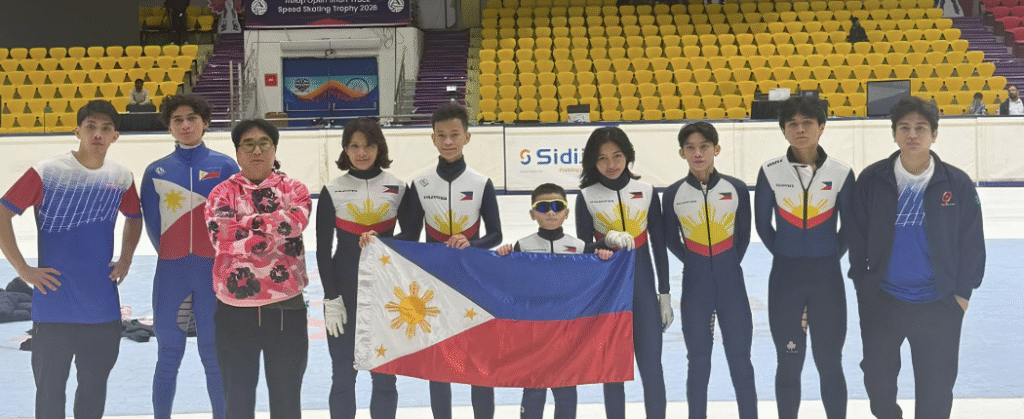
Philippine short track speed skating reached a breakthrough as three homegrown athletes captured four medals at the Asian Open Trophy. Keirsten Fernandez led the historic campaign with two gold medals, while Xsandrie Guimba and Zymone Zurbito also reached the podium.
Fernandez Delivers Two Historic Gold Medals
Thirteen-year-old Keirsten Layne Fernandez captured the Junior C Girls’ 1,000-meter gold after finishing the race in 1:44.307. Metro.Style documented the performance as the Philippines’ first gold medal at the Asian Open Short Track Speed Skating Trophy.
Fernandez followed that breakthrough by winning the 777-meter event in 1:19.989, completing an impressive two-gold campaign in India. Her victories made her the Philippines’ most successful athlete at the competition while establishing two new milestones for Philippine short track.
Fernandez Shows Promise Across Different Racing Distances
Winning both events showed Fernandez could deliver successful performances across two distances during the same international short track competition. Those results also provide valuable competitive experience as the 13-year-old continues developing race management, positioning, acceleration, and tactical awareness.
Guimba and Zurbito Expand Philippine Medal Haul
Xsandrie Guimba added a senior-level result by claiming silver in the women’s 1,000 meters with a recorded time of 1:52.003. Her podium finish gave the Philippine campaign representation beyond the younger categories and contributed another medal to the breakthrough performance.
Eight-year-old Zymone Zurbito opened the country’s medal haul by taking bronze in the Junior F Boys’ 333-meter competition. As the Philippines’ youngest medalist at the event, his result highlighted development occurring across multiple age groups within the national program.
Homegrown Skaters Trace Development to Local Ice Programs
All three medalists began skating through SM Skating before eventually progressing toward international short track competition and representing the Philippines abroad. Their development illustrates how access to domestic ice facilities can provide an entry point before athletes transition toward structured competitive training.
Joseph Francis Silva of SM Sports and Leisure Center emphasized continued development when discussing the Filipino medalists’ performances in India. SM Skating also works alongside the Philippine Skating Union to provide training pathways for athletes pursuing competitive opportunities.
“Every champion starts with a first step on the ice. We hope to inspire every skater to keep pushing forward, believe in their potential, and pursue their dreams,” Silva said.
Four Medals Mark Philippine Short Track Breakthrough
The Philippines finished its historic campaign with Fernandez winning two golds, Guimba taking silver, and Zurbito earning the opening bronze. Those four medals represented the country’s first podium finishes at the Asian Open Short Track Speed Skating Trophy.
The results also spanned Junior F, Junior C, and senior competition, giving the medal haul significance beyond one successful athlete. Developing competitive skaters across multiple age groups can strengthen continuity as younger athletes gradually progress toward higher international racing levels.
Medal Haul Highlights Emerging Development Pipeline
Zurbito’s bronze, Fernandez’s two golds, and Guimba’s silver show Philippine medal potential across widely separated competitive age categories. Maintaining that progression requires sustained training opportunities as developing skaters encounter faster racing, tactical pressure, and stronger international competition.
Analytical Breakdown
Short track development depends on technical skating, tactical awareness, and racing experience because positioning can change quickly within crowded fields. Fernandez’s two victories provide encouraging evidence of competitive progress, while Guimba and Zurbito broaden the Philippines’ emerging international depth. Converting this breakthrough into sustained success will require consistent training and increasingly demanding competition across each athlete’s development pathway.