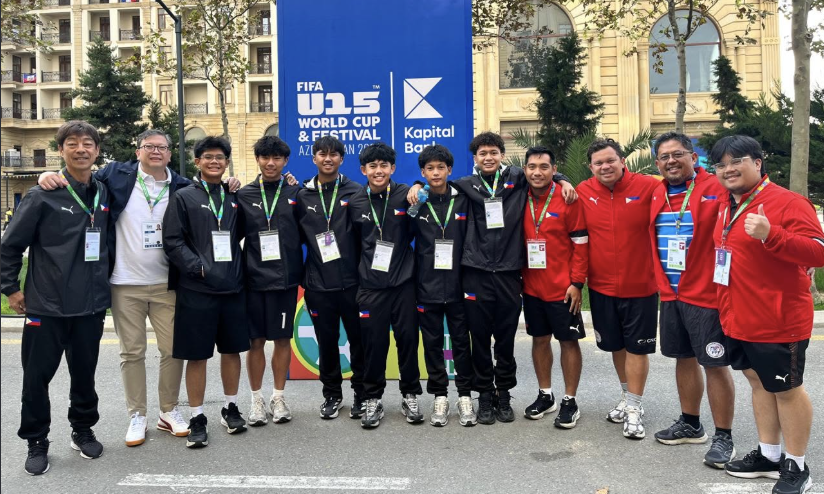
The Philippine Under-15 men’s national football team will begin a historic international campaign against Morocco Saturday in Baku, Azerbaijan. The young Filipinos enter the inaugural FIFA U15 World Cup and Festival representing a broad domestic and overseas talent pool.
Morocco Provides Opening International Test
The Philippines begins competition against Morocco at the Hovsan Competition Complex during Saturday’s opening assignment in Azerbaijan. Facing a strong football nation immediately provides the Filipino teenagers with an demanding benchmark at the beginning of their international campaign.
Youth international tournaments should prioritize development alongside results because players remain years away from their senior competitive peaks. The Morocco match can reveal how Philippine prospects handle faster decisions, stronger opposition, and unfamiliar tactical situations under international pressure.
Opening Match Offers Immediate Development Benchmark
Playing established football nations gives young Filipinos experience difficult to reproduce entirely through domestic youth competitions. Coaches can evaluate technical execution and tactical awareness while players learn how international opponents punish mistakes more quickly.
Roster Draws Players From Multiple Regions
The Philippine roster includes players developed across Luzon, the Visayas, Mindanao, North America, and Europe before joining the national program. That geographic spread demonstrates the federation’s attempt to identify eligible talent beyond traditional Metro Manila youth football pathways.
Goalkeepers Jordan Tan and Keanefred Cristiane Versales enter from Makati FC and De La Salle-Zobel respectively. Defenders include players connected with Southridge, FA Manila, Panabo, Makati FC, Negros Occidental, and Arayat FC across the national pool.
Wider Recruitment Expands National Talent Search
Youth national teams become stronger when selection systems identify players across multiple regions instead of concentrating upon established academies. The challenge involves integrating different developmental backgrounds into one coherent playing identity during relatively short national-team preparation windows.
Tournament Marks Milestone for Youth Program
Philippine Football Federation president John Anthony Gutierrez described participation as a milestone for the players and national youth program. Competing in the inaugural event gives the Philippines valuable exposure while FIFA continues expanding structured international opportunities for younger age groups.
The tournament should also help coaches compare Philippine development standards directly against countries possessing longer-established youth systems. Those comparisons become most useful when lessons influence future coaching, academy structures, scouting, and competition opportunities after the team returns home.
Participation Must Produce Long-Term Lessons
Simply appearing internationally provides limited developmental value unless federations study the technical and tactical differences exposed during competition. Philippine coaches should use Azerbaijan to identify specific improvements required before these players progress toward older national-team age groups.
Young Players Begin Longer National Pathway
Under-15 competition represents an early stage rather than an accurate predictor of which players will eventually reach senior international football. Physical development, coaching environments, playing opportunities, injuries, and individual commitment can significantly reshape prospects during the following years.
The federation therefore needs continuity between U15, U17, U20, U23, and senior levels to preserve promising talent. Players identified today require competitive matches and quality training after this tournament rather than disappearing between national-team windows.
Development Cannot End After Azerbaijan
Youth tournaments create visibility, but consistent club minutes and structured coaching ultimately determine whether promising teenagers continue progressing. The strongest legacy from this event would involve several players eventually advancing through subsequent Philippine national youth teams.
Historic Opportunity Carries Manageable Expectations
The significance surrounding a first tournament appearance can create unnecessary expectations for players still developing technically and physically. Results matter competitively, but judging teenagers exclusively through wins and losses would overlook the broader purpose surrounding youth international football.
Strong performances should instead combine courage in possession, defensive organization, tactical learning, and visible adaptation across successive matches. Those indicators can reveal meaningful progress even when the Philippines encounters opponents currently operating at stronger developmental levels.
Youth Success Requires Broader Evaluation
Scoreboards provide immediate outcomes without fully explaining whether young players improved across an international tournament. Coaches should evaluate decision-making, positioning, technical execution, and adaptation alongside results when determining whether Azerbaijan advanced the team’s development.
Analytical Breakdown
Facing Morocco immediately gives the Philippine U15 team an excellent benchmark against a respected international football system. The roster’s geographic diversity expands recruitment, but integrating players from different developmental environments remains an important coaching challenge. Azerbaijan becomes valuable if lessons continue through U17 and U20 pathways rather than ending with one historic tournament.