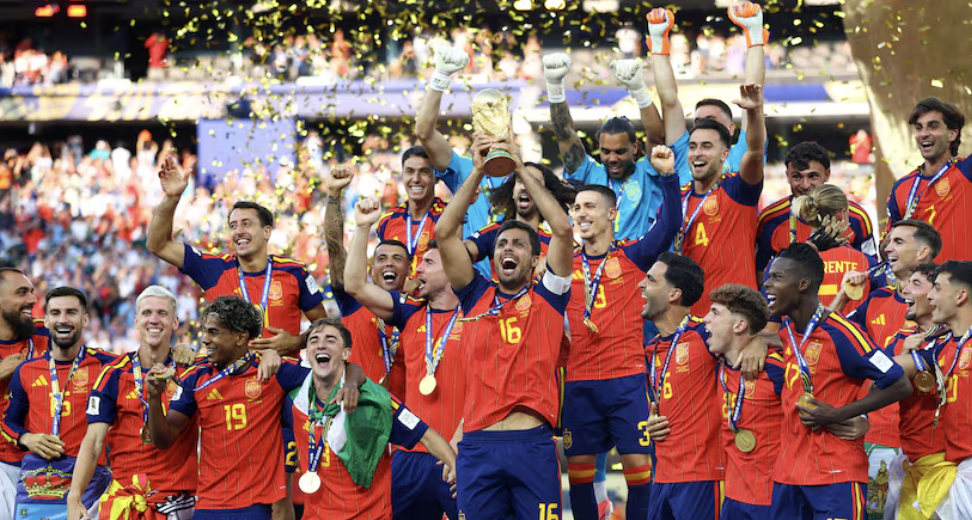
La Roja Ends Argentina’s Reign With Historic Triumph
Spain reclaimed football’s biggest prize after defeating defending champion Argentina in a tense extra-time battle at the 2026 FIFA World Cup final. The victory secured La Roja’s second world championship and completed a remarkable return to the summit of international football after their historic triumph in 2010.
Spain Controls Match Before Late Breakthrough
Spain dictated possession from the opening whistle by controlling midfield spaces and forcing Argentina to spend long stretches without the ball. Their patient build-up play repeatedly stretched the defending champions while creating dangerous opportunities around Emiliano Martinez’s penalty area.
Anadolu from PNA reported that Lamine Yamal tested Martinez early as Spain’s midfield prevented Argentina from establishing any attacking rhythm throughout the opening half. Lionel Messi also found little space to influence the match because Spain’s disciplined defensive structure limited the reigning champions to no shots on target before halftime.
Tactical Discipline Defined the First 90 Minutes
Spain consistently advanced through Argentina’s midfield with quick one-touch passing combinations while maintaining excellent positional balance across the pitch. Argentina’s disciplined defensive shape absorbed constant pressure and forced extra time despite spending much of the match defending inside its own half.
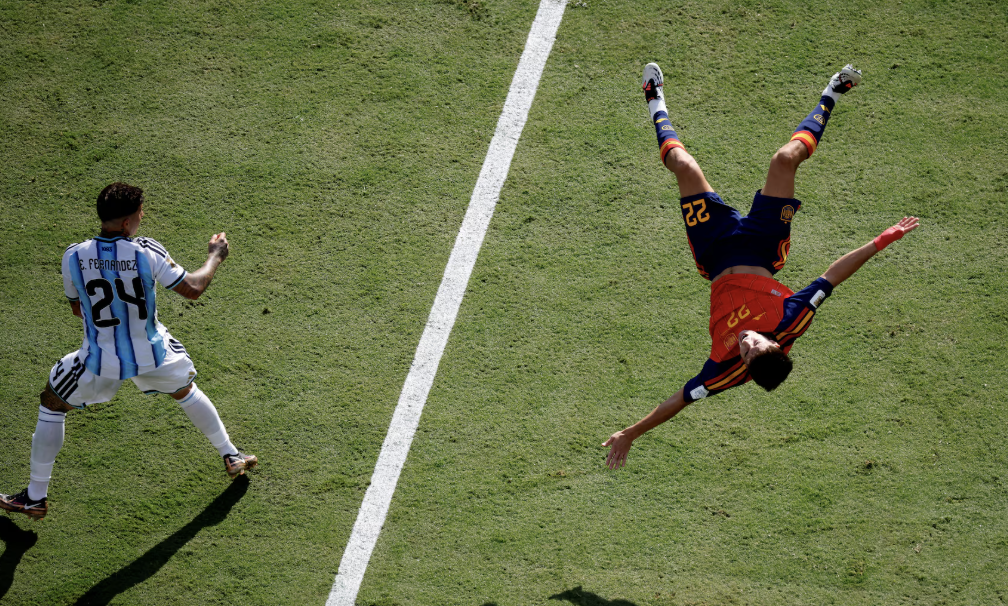
Image from: Reuters
Argentina Pushes Forward Despite Costly Red Card
Lionel Scaloni’s side emerged from halftime with greater urgency by pressing higher and challenging Spain’s passing rhythm across the midfield. The tactical adjustment produced a far more competitive second half despite Argentina continuing to struggle for clear scoring opportunities.
Momentum shifted again when Enzo Fernandez received a late red card, forcing Argentina to finish extra time with only ten players. The numerical disadvantage limited their attacking options and made defending Spain’s relentless pressure increasingly difficult during the closing stages.
Ferran Torres Delivers the Defining Moment
With penalties appearing increasingly likely, Spain finally converted its territorial dominance into the decisive breakthrough during extra time. Patient attacking movement once again opened space behind Argentina’s defense at the most important moment of the championship match.
Pedro Porro delivered an accurate cross toward the back post where Nico Williams intelligently redirected the ball into the danger area. Ferran Torres reacted first and fired his finish into the roof of the net in the 106th minute to secure Spain’s second FIFA World Cup title.
Recommended Article: Messi Fires Back at World Cup Critics After Win
Match Highlights
- Final Score: Spain 1, Argentina 0 (after extra time)
- Winning Goal: Ferran Torres, 106th minute
- Build-up: Pedro Porro cross and Nico Williams header
- Venue: New York New Jersey Stadium, United States
- Spain’s FIFA World Cup titles: 2010 and 2026
- Argentina completed extra time with ten players after Enzo Fernandez’s red card
Spain’s New Generation Reaches Football’s Summit
Spain’s latest triumph showcased the successful transition from its legendary 2010 World Cup-winning generation to a talented new core capable of competing at the highest level. Emerging stars accepted greater responsibility while maintaining the tactical identity that has defined Spanish football for more than a decade.
Players such as Lamine Yamal, Nico Williams, and Ferran Torres combined youthful creativity with disciplined execution throughout the tournament. Winning both the UEFA European Championship and the FIFA World Cup within the same competitive cycle further confirmed Spain’s return among world football’s elite nations.
Analytical Breakdown: The Return of a Champion
World Cup finals are often decided by which team can consistently control space and tempo rather than simply dominate possession. Spain achieved that balance by limiting Argentina’s opportunities to transition quickly, maintaining midfield superiority, and forcing the defending champions into low-percentage attacking situations throughout much of the match. Although the winning goal arrived in extra time, Spain’s territorial control and defensive organization had already established the foundation for the result.
The victory also highlights the evolution of Spain’s football identity across different generations. While the squad features emerging talents such as Lamine Yamal, Nico Williams, and Ferran Torres, it continues to rely on the positional discipline, technical precision, and collective movement that have defined Spanish football for more than a decade. Successfully blending experienced internationals with younger players has allowed Spain to remain competitive while adapting to the changing demands of elite international football.
Frequently Asked Questions
Who won the 2026 FIFA World Cup?
Spain defeated Argentina 1-0 after extra time to win the 2026 FIFA World Cup.
Who scored the winning goal?
Ferran Torres scored the championship-winning goal in the 106th minute of extra time.
How many FIFA World Cups has Spain won?
Spain has won two FIFA World Cup championships after lifting the trophy in 2010 and 2026.
Why did Argentina finish with ten players?
Enzo Fernandez received a red card during extra time, forcing Argentina to complete the match with ten players.
Where was the 2026 FIFA World Cup final played?
The final was played at New York New Jersey Stadium in the United States.
Disclaimer: Headline Image from Reuters.