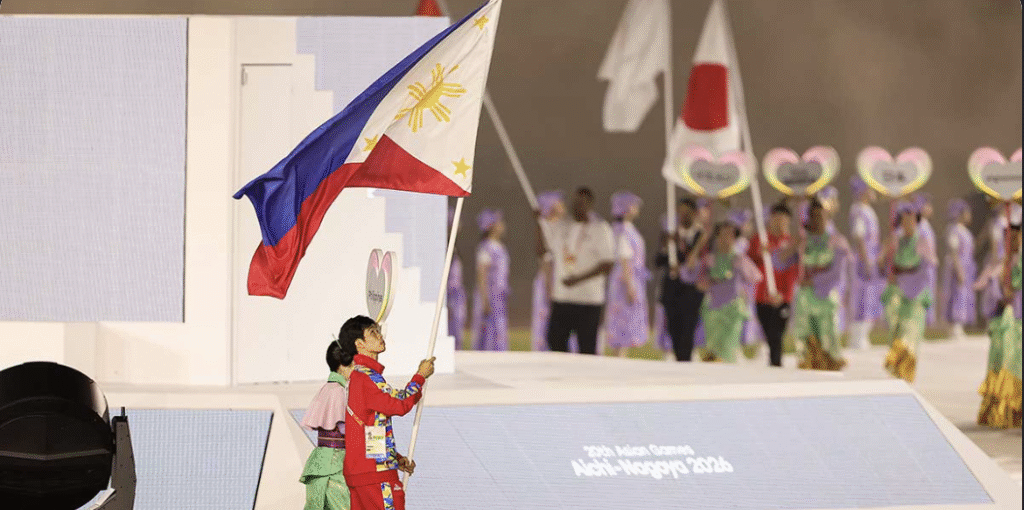
Abraham Tolentino continues defending the Philippines’ eight-gold Asian Games projection despite the national delegation finishing with four championships. Nine silver medals underpin his argument, while sports officials now want Nagoya’s broader success converted into stronger government investment.
Tolentino Points to Nine Silvers Behind Eight-Gold Target
ABS-CBN News’ Paige Javier documented Tolentino defending the projection during Team Philippines’ homecoming gathering in Manila. The Philippine Olympic Committee president argued that several silver medalists came sufficiently close to winning their respective championship matches.
The Philippines ultimately collected four golds, nine silvers, and 16 bronzes, producing its largest overall Asian Games haul since 1966. Its four championships matched totals from Jakarta-Palembang 2018 and Hangzhou 2023 while finishing four golds below the Nagoya projection.
“I can say that hindi ko pwedeng ikahiya na kaya talaga yung eight [gold medals].”
“I can explain it. I can, yung mga magtatanong, no, nasaan na yung eight? Yes, it was eight. Doon lang tayo pipitas sa silver.”
Silver Medals Give Projection Some Competitive Context
Nine runner-up finishes demonstrate the Philippines created considerably more championship opportunities than its four-gold total alone might suggest. They cannot retrospectively become victories, but reaching nine finals provides useful context when evaluating how competitive the original projection became.
Close Finals Fuel Tolentino’s Defense of Projection
Tolentino specifically cited Carlo Paalam’s boxing final while questioning circumstances surrounding several other Philippine silver-medal results. He also referenced close outcomes involving jiu-jitsu, taekwondo, and Jean Claude Saclag’s mixed martial arts championship appearance.
Those comments represent Tolentino’s assessment rather than evidence that officiating definitively prevented additional Philippine Asian Games championships. Tournament results remain official, making four golds the appropriate benchmark despite arguments surrounding how narrowly several championship opportunities disappeared.
“Kay Carlo Paalam, nakita niyo naman. ‘Di ba? Kayo na humusga doon. That’s a sure gold.”
“Kay Saclag sa MMA. Matagal ko na sinasabi yun na may nakatago yung silver niya.”
Narrow Defeats Still Reveal Areas Worth Studying
Close championship losses should encourage technical evaluation rather than assumptions that different officiating would necessarily have produced victories. Coaches can examine tactics, scoring margins, decision-making, and execution to determine where future finalists can create more decisive advantages.
Bossong Bronze Adds Another Debate Over Missed Gold
Tolentino also identified Victoria Bossong’s women’s 800-meter bronze as another performance he believed carried championship potential. Bossong recorded 2:02 during preliminary competition before running 2:04 in the final, where she ultimately finished third.
The difference between those performances illustrates how qualifying speed does not guarantee identical execution during a championship race. Race positioning, pacing, opponents, and tactical conditions can change significantly between preliminary rounds and finals at major international competitions.
“One bronze that should have been gold, with due respect to Victoria [Bossong].”
“It’s more than eight. So, but still, we are very, very happy sa result.”
Medal Potential Differs From Medal Certainty
Athletes demonstrating championship-level performances deserve recognition as legitimate contenders without treating their best previous result as a guaranteed final outcome. Bossong’s bronze remains an encouraging breakthrough that can provide a measurable starting point for her next international development phase.
Young Medalists Strengthen Philippine Development Outlook
Philippine Sports Commission chairman Patrick Gregorio highlighted the number of young athletes contributing medals throughout the successful Nagoya campaign. He described their ages as encouraging evidence for grassroots programs and future initiatives designed to strengthen regional athlete development.
Programs including the Southeast Asian Games Youth Plus and regional training centers form part of that longer development approach. Gregorio also encouraged athletes to ignore social-media criticism and concentrate upon training, competition, and representing the Philippines internationally.
“Very happy ako na yung mga nagmedalya. Nakita ko yung age group, talagang mga bata. Talagang very promising.”
“Tuloy-tuloy po ang suporta namin sa inyo. Kung ano po ang sinasabi nila sa social media, wag nyo na pong isipin yun.”
Youth Success Requires Patience Beyond One Medal Cycle
Young medalists provide valuable evidence of development without guaranteeing that each athlete will eventually become an Olympic contender. Their progression depends upon sustained coaching, competition exposure, sports science, recovery, and opportunities extending beyond one successful continental tournament.
Asian Games Results Strengthen Funding Argument
Tolentino wants Olympic medal-producing sports prioritized as Philippine preparations increasingly turn toward the Los Angeles Games in 2028. He argued that government funding should remain continuous rather than slowing after athletes completed their successful Asian Games campaign.
Gregorio said sports officials would approach the Senate seeking resources for several upcoming international competitions and development programs. Those include the 2027 Southeast Asian Games, SEA Games Youth Plus, Asian Beach Games, and preparations for Los Angeles.
“So lahat yun, bubuhusan. In short, doon ang focus, doon ang direction, doon din ang focus ng funding ng government.”
“Huwag bibitaw. Huwag bibitinin. Dapat buhos.”
Funding Debate Moves From Rewards Toward Preparation
Medal incentives compensate athletes after successful performances, while preparation budgets determine opportunities available before future competitions begin. Nagoya therefore gives sports officials recent performance evidence when arguing for funding covering coaching, training, qualification, and international exposure.
Analytical Breakdown
Nine silvers support the argument that Philippine athletes created numerous championship opportunities, but they cannot transform four official golds into eight. The more productive response is studying those narrow losses while strengthening systems that helped younger athletes reach Asian podiums. Future targets become more credible when ambitious projections are supported by sustained funding, realistic performance evidence, and complete athlete preparation.