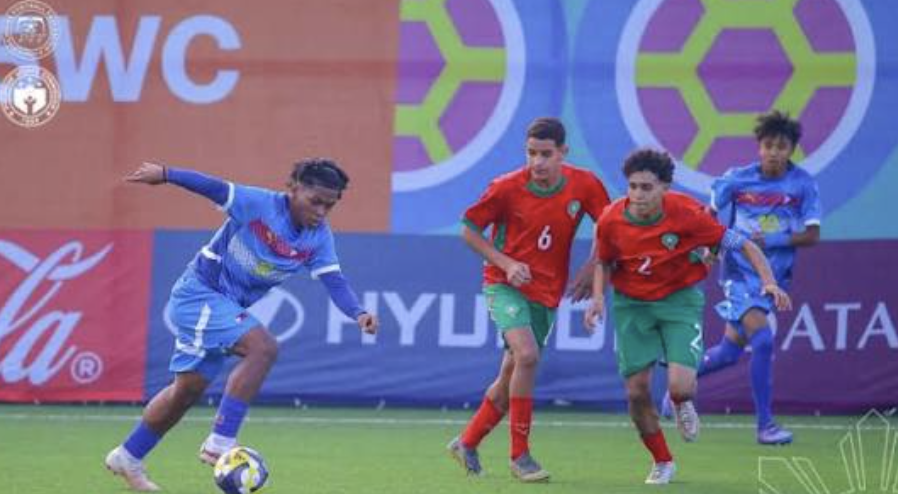
The Philippine Under-15 men’s football team lost 2-0 against Morocco Saturday during its historic international tournament debut in Azerbaijan. Two early Moroccan goals decided the opening Group F match at the Hovsan Sports Complex in Baku.
Morocco Strikes Twice During Opening Minutes
Safouane Bellamine opened Morocco’s scoring during the sixth minute, immediately placing the Philippines under pressure during its first assignment. Said Noufii doubled the advantage in the 17th minute, giving Morocco control before the match reached its opening quarter.
Conceding twice early forced the young Filipinos to chase against opponents representing a significantly more established football development system. The Philippines nevertheless prevented Morocco from increasing its advantage throughout the remaining minutes after absorbing the difficult opening sequence.
Early Goals Create Immediate Learning Test
Youth teams can struggle when conceding early because players possess less international experience managing sudden momentum changes. The Philippines needed to regain organization quickly, making the scoreless remainder an encouraging response despite the eventual two-goal defeat.
Filipinos Stabilize After Difficult Start
Morocco failed to score again after the 17th minute despite entering the match with considerable technical and developmental advantages. That defensive stabilization gave the Philippines useful evidence that adjustments can work even after an international opponent establishes early control.
Young players benefit from learning how to remain competitive after unfavorable starts rather than allowing matches to unravel completely. The ability to recover structurally becomes especially important during short tournaments where another assignment can arrive within one day.
Response Matters Beyond Final Score
A 2-0 defeat provides the official result without fully explaining how the match changed after Morocco’s second goal. Philippine coaches should examine which adjustments reduced later opportunities because those lessons can become immediately useful during subsequent tournament assignments.
Historic Tournament Provides New Experience
The inaugural FIFA U15 World Cup and Festival runs from October 24 through 30 in Baku, Azerbaijan. The Philippines joined Morocco, Belize, Costa Rica, Curaçao, and Liberia within a group offering several contrasting football environments.
Facing opponents from different confederations gives Filipino teenagers exposure unavailable through exclusively Southeast Asian youth tournaments. Players must adapt quickly toward different pressing structures, physical profiles, tempo, and technical approaches throughout a compressed competition schedule.
Variety Can Accelerate Youth Learning
Youth development benefits when players encounter problems their regular club competitions rarely present at comparable intensity. Azerbaijan can expand the Filipino squad’s tactical understanding if coaches translate each international challenge into specific lessons rather than focusing exclusively on results.
Philippine Roster Reflects Wider Talent Search
The national team includes players developed across Philippine regions alongside eligible prospects based in North America and Europe. That broad recruitment strategy expands the available talent pool while creating another challenge involving integration across different football environments.
Short national-team camps provide limited time to establish shared tactical habits between players accustomed to different club systems. International tournaments therefore test not only individual ability but whether coaches successfully build enough collective understanding from a geographically diverse roster.
Integration Remains Essential for Youth Program
Recruiting widely only strengthens national teams when players eventually function within one coherent football structure. The Philippine youth program must create enough continuity between camps so tactical understanding develops alongside the broader search for eligible talent.
Results Should Not Define Young Players
Under-15 football sits far too early within player development to treat one international result as evidence of future potential. Physical maturation and technical progression can change dramatically before these teenagers approach senior national-team consideration several years later.
The federation should therefore evaluate individual decision-making, tactical understanding, technical execution, and adaptability alongside tournament outcomes. Azerbaijan becomes most valuable when lessons influence club development and future U17 assignments after players return from the competition.
Long-Term Progress Matters More Than One Loss
Morocco’s victory reflects the current performance difference between two youth teams rather than determining their players’ eventual senior careers. Philippine prospects need sustained competitive opportunities after Azerbaijan if this historic tournament appearance is expected to produce lasting developmental value.
Next Matches Offer Immediate Opportunity
The tournament’s condensed format gives the Philippines little time to dwell upon its opening defeat against Morocco. Additional group opponents provide opportunities to apply lessons immediately while coaches adjust selections and tactical priorities based upon Saturday’s performance.
Improvement can appear through better starts, cleaner possession, stronger defensive organization, and more consistent chance creation even before victories arrive. Those markers should guide evaluation throughout the tournament while players continue gaining experience against unfamiliar international opposition.
Tournament Response Becomes Next Test
Youth competitions reward teams capable of learning quickly because several matches arrive within a short competitive window. The Philippines must now demonstrate that Saturday’s difficult opening minutes produced lessons visible during its next international assignment.
Analytical Breakdown
The Philippines paid heavily for two early defensive breakdowns before stabilizing against a considerably more established football nation. Preventing another Moroccan goal after the 17th minute provides useful evidence that the young Filipinos adjusted during competition. Azerbaijan should be judged through development and adaptation, not simply results, because these players remain years from senior football.