Championship Chase Begins After Dominant Group Performances
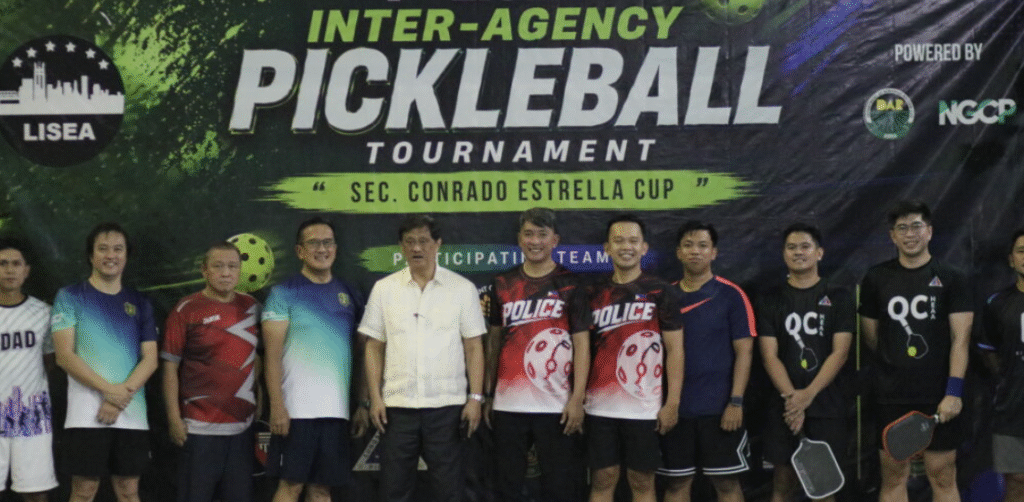
Three undefeated tandems headline the LISEA Pickleball Tournament Top 16 after completing the elimination stage in Quezon City. The remaining partnerships now enter knockout competition chasing the inaugural Sec. Conrado Estrella III Cup men’s doubles championship.
Three Unbeaten Tandems Lead Knockout Field
Manila Standard Sports detailed the qualifiers advancing from a men’s doubles competition that began with 36 participating teams. PNP representatives Paul Armas and Gary Napaton completed elimination play undefeated, carrying an unblemished record into the tournament’s knockout phase.
BIR’s Daryl Alingasa and John Kerin Nastor also remained unbeaten, matching UP Diliman’s Jien Camontoy and Odilon Badong. Those perfect preliminary records demonstrate consistency, although elimination competition now places greater consequences on every tactical adjustment and scoring opportunity.
Image from: Business Mirror
PNP, BIR and UP Diliman Finish Perfect
- PNP: Paul Armas and Gary Napaton completed elimination competition without suffering a defeat before reaching the Top 16.
- BIR: Daryl Alingasa and John Kerin Nastor also navigated their preliminary schedule without losing a match.
- UP Diliman: Jien Camontoy and Odilon Badong completed the undefeated trio entering the knockout portion of competition.
DAR and NGCP Remain in Estrella Cup Race
Department of Agrarian Reform representatives Orlando Reyes and Crisostomo Bernaldez advanced, keeping the host agency represented during knockout competition. Their qualification gives DAR another opportunity to compete when the remaining tandems return for the tournament’s decisive championship stage.
Michael Javier and Ronald Dylan Concepcion also qualified for the National Grid Corporation of the Philippines after elimination competition. Both partnerships now face opponents emerging from different brackets, creating fresh tactical matchups after advancing through their respective preliminary schedules.
Government Institutions Represented in Top 16
Reaching the knockout stage requires partnerships to adjust quickly because previous opponents cannot fully prepare teams for different playing styles. Defensive tandems, aggressive attackers, and patient kitchen players can each demand different responses during increasingly consequential matches.
Thirty-Six Teams Highlight Inter-Agency Participation
The inaugural men’s doubles competition started with 36 teams divided across four brackets during the preliminary stage. That field provides meaningful scale for an event designed around organized pickleball competition among participating government institutions and organizations.
Structured tournaments give recreational players opportunities to experience competitive match situations beyond casual games or regular practice sessions. Repeated tournament exposure can also improve decision-making because players encounter unfamiliar opponents, tactical adjustments, and increasingly consequential points.
Tournament Creates Another Organized Pickleball Platform
The Estrella Cup provides another competitive setting where players can test partnerships against opponents representing different participating organizations. Regular organized matches also encourage players to develop communication, positioning, and shot selection under conditions carrying measurable competitive consequences.
Recommended Article: Ruben Gonzales, Kelsey Laurente Ready for Pickleball World Cup
Knockout Format Changes Tactical Priorities
Preliminary brackets reward consistency across multiple matches, while knockout competition places considerably greater weight on immediate execution and adjustment. Single elimination increases pressure on return depth, serving accuracy, positioning, communication, and disciplined decision-making around the non-volley zone.
Strong doubles partnerships must protect middle space while recognizing when attacking aggressively creates unnecessary risk during neutral exchanges. Effective resets can restore favorable positioning, while controlled returns help teams reach the kitchen before opponents establish sustained positional pressure.
Kitchen Control and Returns Become More Important
- Return depth: Deeper returns can delay opponents approaching the kitchen while giving the returning partnership additional positioning time.
- Middle communication: Clear responsibility reduces hesitation when balls enter spaces both partners could reasonably attempt to cover.
- Patient resets: Neutralizing difficult attacks can create opportunities to rebuild positioning instead of forcing low-percentage counterattacks.
- Transition discipline: Players caught between the baseline and kitchen must avoid attacking recklessly from vulnerable court positions.
- Partnership spacing: Coordinated movement helps prevent open lanes while keeping both players prepared for accelerated exchanges near the kitchen.
September 17 Knockouts Decide First Champion
The tournament resumes September 17, 2026, with the remaining partnerships entering the knockout stage of the inaugural competition. One tandem will emerge as the first men’s doubles champion of the Sec. Conrado Estrella III Cup after elimination concludes.
The three unbeaten partnerships enter with strong preliminary results, but those records cannot substitute for execution during elimination matches. Other qualifiers receive the same opportunity to advance by adapting quickly, protecting court position, and managing pressure throughout decisive rallies.
Unbeaten Records Meet Single-Elimination Pressure
Previous results provide useful evidence of consistency, but knockout matches demand immediate solutions whenever opponents disrupt familiar patterns. Partnerships maintaining communication and disciplined positioning can better manage momentum swings when one difficult sequence threatens their tournament campaign.
Analytical Breakdown: Every Point Matters More
Knockout rounds place greater emphasis on disciplined doubles play because every point can influence the outcome of an entire tournament. Successful partnerships communicate clearly, protect the middle of the court, and make patient decisions instead of forcing difficult attacking shots.
Undefeated elimination records provide confidence, but they offer no advantage once single-elimination matches begin. Teams that adapt quickly to different opponents and maintain consistent court positioning often perform better under the added pressure of championship competition.
Frequently Asked Questions
When is the LISEA Pickleball Tournament Top 16?
The Top 16 knockout phase of the inaugural LISEA Pickleball Tournament is scheduled for September 17, 2026.
Which LISEA pickleball teams remain undefeated?
PNP’s Armas-Napaton, BIR’s Alingasa-Nastor, and UP Diliman’s Camontoy-Badong completed the elimination stage without suffering a defeat.
How many teams entered the LISEA Pickleball Tournament?
The men’s doubles competition started with 36 teams representing participating organizations and competing across four preliminary brackets.
Is the Department of Agrarian Reform still competing?
Yes, DAR representatives Orlando Reyes and Crisostomo Bernaldez qualified for the Top 16 and remain in championship contention.
What championship are the LISEA teams competing for?
The remaining tandems are competing to become inaugural champions of the Sec. Conrado Estrella III Cup men’s doubles competition.
Disclaimer: Headline Image from Manila Standard.