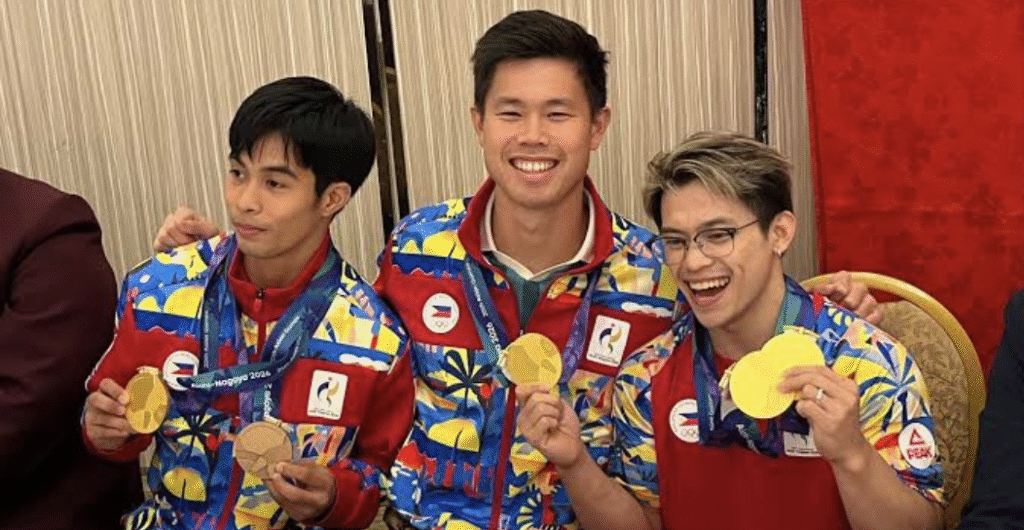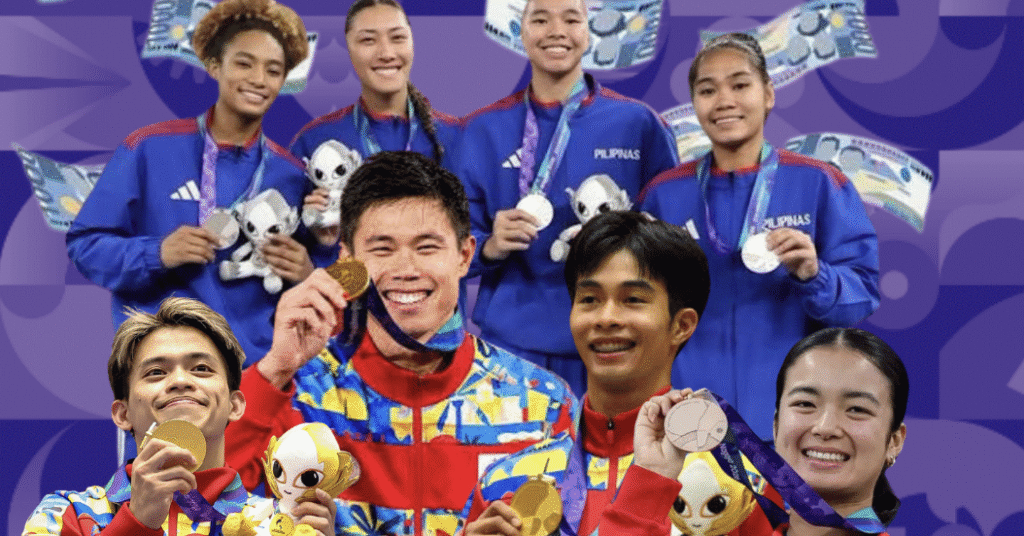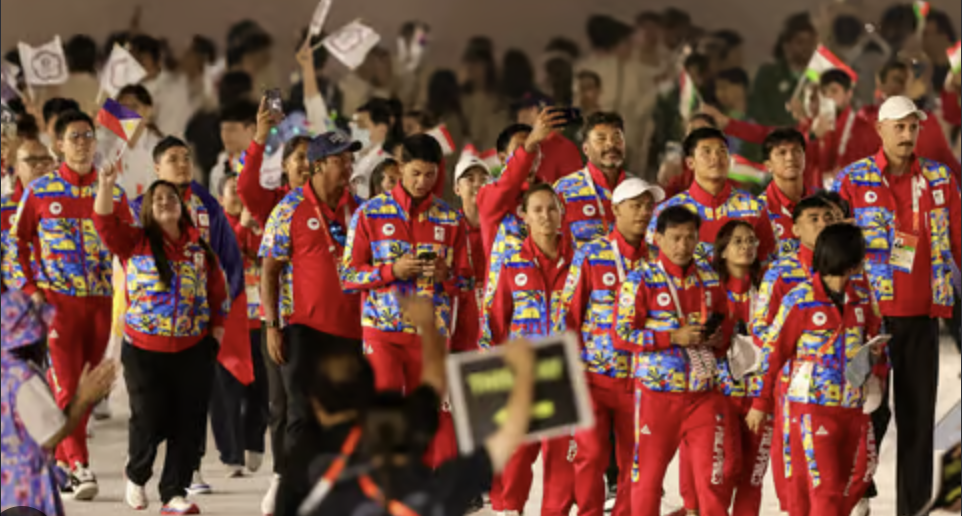
The Philippines leaves Nagoya with 29 medals, but its more important journey now points toward Los Angeles. Thirteen medals came from confirmed LA 2028 events, giving the historic campaign immediate relevance beyond the Asian Games.
Yulo and Obiena Give LA 2028 Push Proven Foundations
The Inquirer Sports Desk identified Carlos Yulo and EJ Obiena among athletes capable of spearheading another Philippine Olympic campaign. Yulo won floor exercise and vault gold, while Obiena successfully defended his Asian Games men’s pole vault championship.
Their three victories accounted for most Philippine golds coming from disciplines already confirmed within the Los Angeles Olympic program. Unlike emerging prospects, both stars also possess extensive experience performing against elite opposition under major international championship pressure.
Three Asian Games Golds Already Belong to Olympic Events
Yulo’s floor and vault titles directly correspond with the apparatuses where he captured his historic Paris Olympic championships. Obiena’s pole vault victory similarly strengthens an Olympic pathway already established through years competing among the world’s leading vaulters.
Eala and Emerging Medalists Expand the Olympic Picture
Alex Eala’s women’s singles bronze came from another confirmed Olympic discipline, keeping tennis within the country’s developing Los Angeles picture. Her Nagoya experience also strengthened familiarity with representing the Philippines inside multisport competitions carrying pressures beyond regular professional tournaments.
Victoria Bossong and John Cabang Tolentino reached athletics podiums, while Jayuard Alciso earned bronze through men’s shortboard surfing. Beach volleyball medalists Khy Progella and Sofiah Pagara similarly emerged among athletes whose Asian Games events connect with Los Angeles.
“It’s always an honor. I think it’s different when you play in the SEA Games, Asian Games or the Olympics.”
Bossong Turns Bronze Into a Starting Point
Bossong’s women’s 800-meter bronze represented one of Nagoya’s notable Philippine breakthroughs while immediately sharpening her ambitions beyond continental competition. Her performance established a valuable benchmark, although reaching an Olympic podium will require another substantial progression against deeper global fields.
“I want a podium at the Olympics, so this was honestly a very good stepping stone.”
“This is the biggest competition I’ve gone to by far. Just to land on the podium is a big accomplishment even if it’s not gold.”
Taekwondo Shows Why Medal Counts Need Olympic Context
Jeus Gabriel Derick Yape contributed gold in mixed individual virtual taekwondo and bronze through men’s individual poomsae during Nagoya. Neither event appears on the Los Angeles program, meaning his Asian Games success cannot transfer directly into equivalent Olympic medal opportunities.
Tachiana Keizha Mangin and Kurt Barbosa face a clearer route because their respective kyorugi divisions remain Olympic medal events. Their Nagoya silvers therefore provide continental evidence within categories that can eventually carry them toward qualification for Los Angeles.
Asian Games Success Does Not Always Have Olympic Equivalent
The distinction demonstrates why projecting Olympic prospects requires examining events individually instead of simply carrying an Asian Games medal table forward. Nagoya rewarded disciplines absent from Los Angeles, while other medalists competed in events retaining almost identical Olympic competitive structures.
Cojuangco and Delos Santos Face Necessary Adjustments
Amaya Paz-Cojuangco earned women’s individual compound silver, but Los Angeles will introduce compound archery exclusively through mixed-team competition. Philippine archery therefore plans pairing Cojuangco with 18-year-old Mateusz Vaughn Johnson while pursuing qualification through available pathways and ranking points.
Weightlifter Albert Ian Delos Santos faces another transition because his Asian Games bronze came in the men’s 70-kilogram category. Los Angeles uses a different weight-class structure, requiring the emerging Filipino lifter to eventually compete within another Olympic division.
“LA Olympics 2028 has included a mixed teamcompound event, and hopefully we can make it there. We will try to qualify either through the Olympic qualifiers and ranking points.”
Olympic Potential Still Requires Difficult Development
Hidilyn Diaz-Naranjo described Delos Santos as a potential future Olympian while stressing the considerable distance remaining before Olympic-level contention. Her assessment places his bronze in proper perspective: an encouraging development milestone rather than evidence that Olympic success is already assured.
“He’s the future of weightlifting. He’s a future Olympian, a potential gold medalist.”
“But I was honest with him that realistically, he’s still far from the level of the Olympics.”
“I want to make him understand that the process in the Olympics is very hard.”
Nagoya Gives Philippines a Two-Year Olympic Head Start
The Philippines finished with four golds, nine silvers, and 16 bronzes, its largest Asian Games collection since Bangkok 1966. Thirteen medals coming from confirmed Los Angeles events provide a more relevant Olympic indicator than the overall total alone.
Carlo Paalam, Karl Eldrew Yulo, and the women’s 3×3 basketball team add further Olympic-event depth beyond established headline stars. Qualification remains another challenge, but Nagoya has already identified athletes and disciplines deserving focused development during the remaining Olympic cycle.
Thirteen Medals Matter More Than Simple Momentum
Asian Games medals cannot predict Olympic results because global fields introduce different qualification systems, opponents, and competitive standards. They can identify credible pathways, making those thirteen Olympic-event medals valuable evidence for deciding where Philippine preparation should intensify next.
Analytical Breakdown
Nagoya gave Philippine sports something more useful than optimism by revealing which medal-winning performances already connect directly with Los Angeles. Yulo and Obiena provide proven foundations, while Bossong, Eala, Mangin, Barbosa, and others represent different stages of Olympic readiness. The next two years must turn Asian podiums into qualification, development, and preparation capable of surviving a considerably tougher global field.